
 8.5
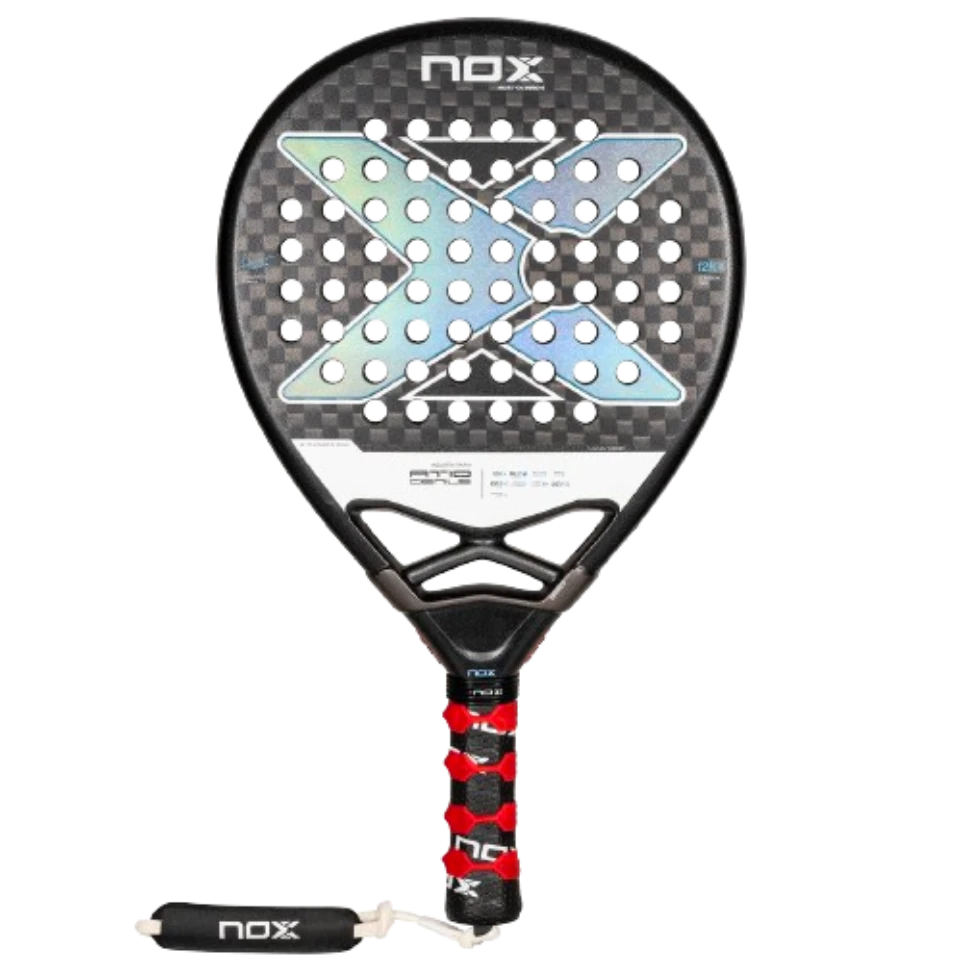
8.5Nox At10 Genius 12K By Agustin Tapia 2024
Nox · 2024
Exceptional maneuverability for a 368g frame
Flat smashes lack real explosiveness
PremiumAdvanced
 8.5
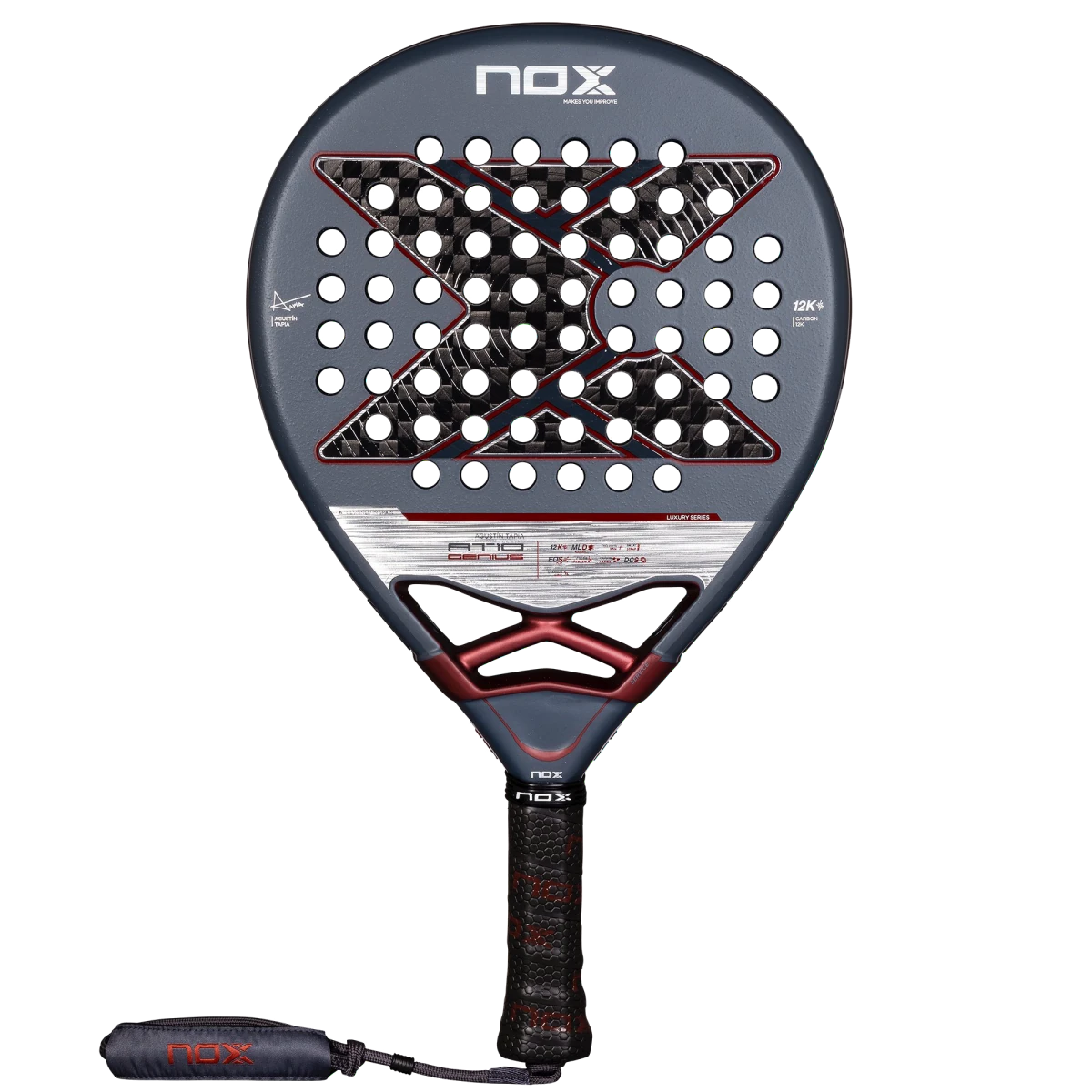
8.5A quick, spin-heavy teardrop with a genuinely large sweet spot, now selling at a mid-range price. Best for advanced all-court players who build points at the net and make their own pace, not for defenders or improvers who need help on slow balls. The short ball exit and a firmer feel through the arm are the real costs.

Developing all-court player focused on consistency and comfort
Always gets an "A" for effort from the coach. That tells you enough about his technique.
The AT10 Genius 12K is the 2025 version of Agustin Tapia's signature racket, and the softer of the two builds Nox made him that season. Where the 18K Alum is the stiff, professional-feeling one, the 12K weave gives a little back: the ball sits on the face a fraction longer, and contact away from the middle is less punishing. It is a teardrop of roughly 360 to 375g with an even balance, which is unusual company for a world number one's racket. Tapia asked Nox to keep the balance low enough to stay fast in defence, and that is the first thing you notice. It moves quickly and it does not tire the arm.
The touch is medium-hard rather than soft, and the whole face is rough, with a 3D hexagonal pattern in the middle and a sand finish around it, so spin costs you very little effort. Street prices have fallen a long way below the original 339.99 euro list price, which is the main reason this racket is still worth discussing: it is now a mid-range purchase with a flagship spec sheet. Against the 2024 AT10 Genius 12K, Nox adjusted the balance for defensive speed and added an octagonal end cap for grip. The 2026 model is a different racket again, with a stiffer Alum Xtrem face and a weight tuning system, so check the year before you buy.
What the Reviewers Say
Reviewers agree on two things. It is very easy to swing, and it hands you no free power.
PadelZoom scored it 9.5 out of 10 for handling and 9 for sweet spot, then named the trade-off without softening it: "The ball exit is its weakest point. It asks for a committed swing, especially in defence or on low balls." Padelful found the same generous sweet spot and gave the surface the credit: "Thanks to its Exclusive Spin technology, even off-centre hits still produce a good result."
Probando Palas played it at every pace and came away happy: "At the back of the court it is a safe bet. The sweet spot is wide, it feels manageable, and it works at a slow pace and at a high one." His one reservation is the new octagonal end cap, whose edges he says are noticeable enough to cost the racket a little comfort.
Pablo Risueno Garcia at Zona de Padel, putting the two 2025 AT10 builds side by side, reads the 12K the other way round: "The more elastic 12K fibres help the ball leave the face, make defence more comfortable and help on off-centre hits." Both readings hold. Next to the 18K this is clearly the friendlier racket. Next to a genuine control racket it still wants you to swing.
The two channels that played the 12K and the 18K back to back read the softness the other way. Conect Padel calls the 12K the firmer and more powerful of the pair, and is blunt about what that costs at the back: "If I do not finish the swing, it gives much less back. I have to make the stroke longer and put more arm into it." Pablo at el4Set still ranks it his favourite of the four 2025 AT10s, and describes the same trade-off: "It is a little harder, so the sweet spot and the comfort shrink slightly, but you gain in power and control." He also tells 2024 owners not to bother upgrading, since almost nothing beyond the surface and the end cap has changed.
The 110 owner reviews collected on Racketguide land at 4 out of 5 and repeat one sentence in different words: "Good control, but I feel it lacks power." Several owners also report a firm, dry feel through the arm, so this is not automatically the comfortable option that the "softer sibling" label suggests.
How it plays..
This is a fast, tidy racket that rewards a full swing and goes quiet the moment you shorten one. The sweet spot is genuinely large and the handling is excellent, so mishits stay in play, but the flat finish from the back is average and the feedback through the arm is firmer than the "12K is the soft one" story suggests. Players still tightening up their technique will get more out of it at the net than at the baseline, and anyone with a history of elbow trouble should hit with one before committing.
Defense
Defence is the honest weak spot. The racket is quick enough to reach the corners and the large sweet spot keeps bad contact alive, but on slow, low balls the ball comes off the face short, so a passive block tends to drop into the net rather than float deep. Reviewers split here: the 12K face is clearly kinder than the 18K, yet it still needs you to accompany the ball rather than just hold the face still. Wall exits go better, because the ball arrives with pace already on it, and that is where several testers rated it highest.
Attack
From the back it builds pace rather than detonating. Commit to the swing and the ball leaves cleanly with good direction, but it will not turn a half swing into a winner. Overhead it is at its best on spin: the rough face and the 12K weave make the bandeja and the vibora bite low off the glass, and the kick smash climbs well. The flat smash is the one shot owners consistently want more from, and a diamond-shaped racket will out-hit it every time.
Netplay
The net is where this racket earns its money. The even balance and the EOS Flap cut-outs make it fast to reset, so quick volley exchanges are comfortable and you place the ball instead of only blocking it. The medium-hard face gives clean feedback on a punched volley, and the surface texture keeps a sliced volley low. Soft drop shots ask for real hand, because there is no trampoline effect helping you.
Our Advice for New Players
Not a beginner racket. The 360 to 375g weight, the medium-hard touch and the short ball exit on a slow swing are exactly the combination that makes early technique feel worse than it is. A round, softer racket at half the price will teach you more.
Our Advice for Intermediate Players
Solid intermediates with a proper swing will enjoy it, especially if your game is built at the net. If you are still learning to hit through the ball, or your matches turn into long defensive rallies, the short ball exit will frustrate you. Hit with one before you buy, and take the arm comfort question seriously.
Competitive level
This is its home. Advanced all-court players who generate their own pace get a fast, spin-heavy racket with a forgiving face at a mid-range price. It suits point builders who attack through the bandeja and vibora more than flat hitters looking for a hammer.
How It Compares
The obvious rival is its own sibling, the Nox AT10 Genius 18K Alum 2025. The 18K is stiffer and more precise, with sharper feedback at the net, and it is the one Tapia's own game points at. Take the 18K if your technique is clean and you want maximum information from every contact. Take the 12K if you want most of that racket with more margin on off-centre hits, for less money.
If defence is the part of your game you want helped, the Bullpadel Neuron 2025 is easier to play from the back and asks less of your swing, at the cost of the AT10's spin bite and net speed.
Research & References
Our mission is to help you choose the right padel racket with clear, in-depth reviews that make it easy to level up your game. We start with official specs, then break down each racket’s key properties. Finally, we bring together trusted video and written reviews—summarised into one consistent, easy-to-read overview.
The sources used for this review:
Drafted by Padelguru from published expert reviews, the official Nox specification and aggregated owner feedback, with Kaj Kloezeman's playing profile as an editorial lens, then reviewed and edited by Kaj Kloezeman. No one at Padelguru play-tested this racket.
Put the rackets you are considering side by side and keep the ones you play with in your collection.
Get the Padelguru app
Recommended for
High intermediate and advanced all-court players, on either side, who attack through the bandeja and vibora and already swing through the ball.
Skill level
High Intermediate, Advanced, High Advanced
Court position
Both sides, Net, Backcourt
Play style
Control, Balanced, Offensive, All-court
Best at: Maneuverability (9.3/10)
Average: 8.3/10
Nox AT10 12K 2025 de Tapia, la ponemos a prueba
18K o 12K, probamos las NOX AT10 2025
Las 4 nuevas AT10 2025 de Tapia a prueba
Shape
Teardrop
Weight
Medium (356–370g)
Balance
Balanced (Even)
Touch
Medium Hard
Core
Mld Black Eva Multilayer
Surface
12K Carbon
Texture
Rough
Year
2025
8 rackets with characteristics, performance and appeal close to the Nox At10 Genius 12K By Agustin Tapia 2025.
8.5Nox · 2024
Exceptional maneuverability for a 368g frame
Flat smashes lack real explosiveness
 8.7
8.7Nox · 2025
Advanced 12K carbon fiber construction reduces weight while maintaining power
Premium price point may be prohibitive for some players
 8
8Nox · 2025
Explosive power on smashes and víboras
Small, high sweet spot punishes off-center hits
 8.8
8.8Nox · 2024
High-quality 12K carbon fiber construction for superior durability
Less effective for purely defensive plays
 8.3
8.3Nox · 2023
Wide, easy sweet spot
Short on raw finishing power
 8
8Nox · 2026
Outstanding maneuverability
Ball can escape at high pace if follow-through is incomplete
 8.4
8.4Nox · 2026
Wide sweet spot for a pro frame
Flat smash output behind the 12K siblings
 9.2
9.2Nox · 2025
Advanced 18K Aluminized Carbon technology for exceptional durability
Premium price point may be prohibitive
Want to explore more options?
Browse all rackets