
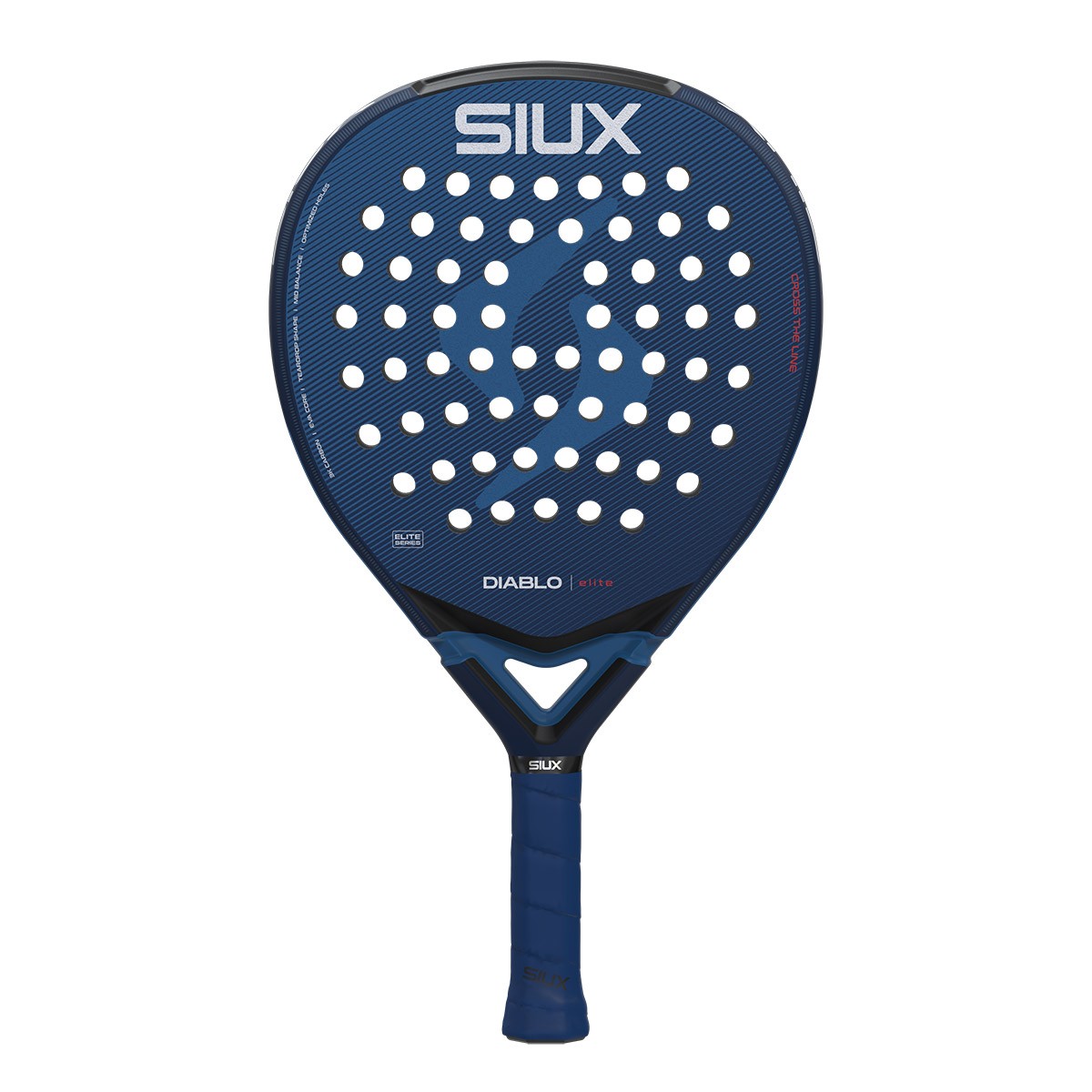
 8
8Siux Diablo Elite 2026
Siux · 2026
Depth from a short swing
Low ceiling on overhead finishing
Mid RangeHigh Intermediate
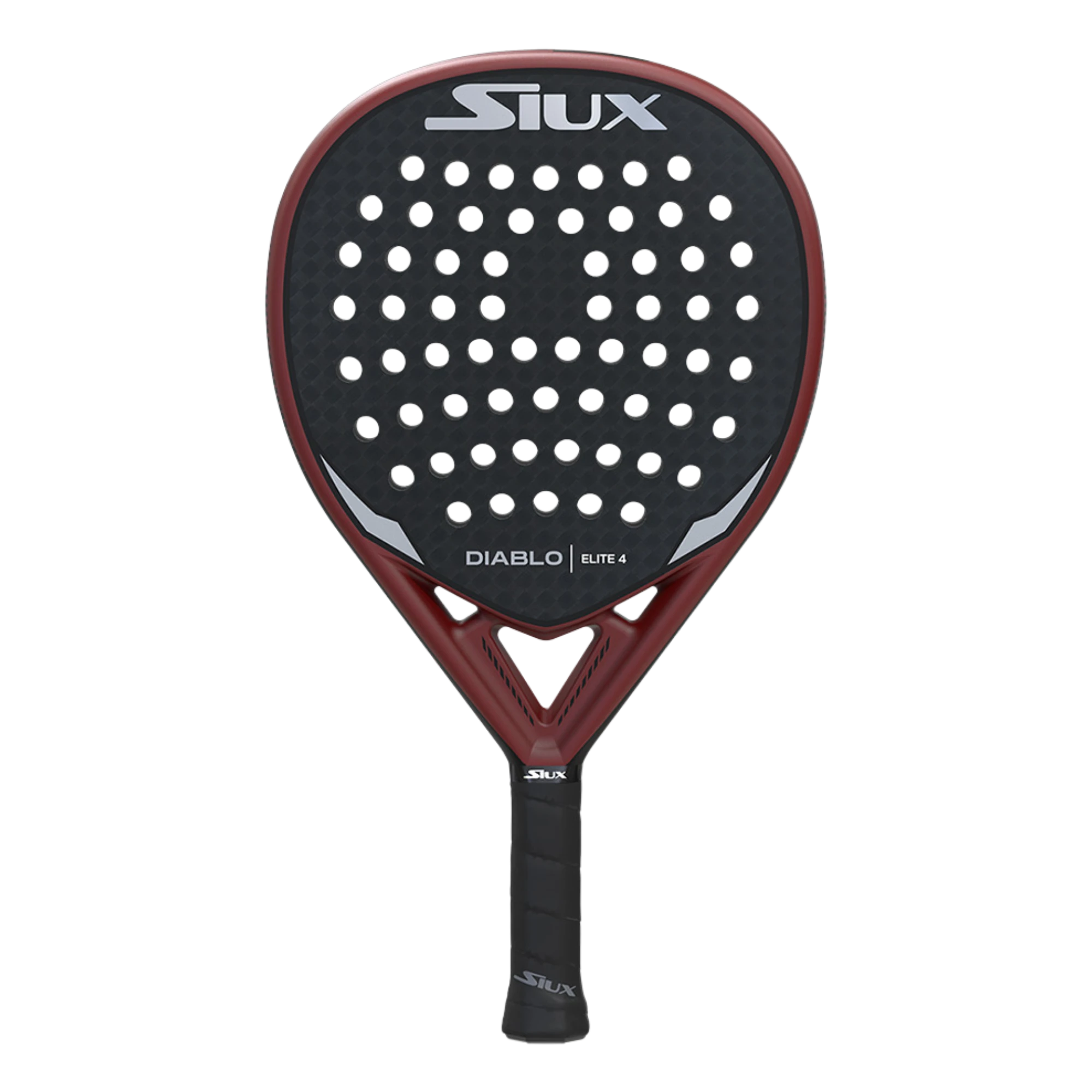 7.6
7.6Reviewers agree this is one of the calmest rackets in its class off the back glass, and one of the least willing when you try to speed the ball up. Right side players who build points and lob will get a lot from it, while anyone learning to finish will fight it. The smooth face also gives almost no spin help.

All-court player who prizes control, feel and spin
Bowe is convinced that the racket, shoes, court are the problem, never his own abilities.
The Diablo Elite 4 2025 is the mid tier of Siux's oldest line, one clear step below the Diablo Pro that the brand's sponsored players use. Elite is the accessible version: a hybrid head on a medium balance, around 355 to 375g, with an EVA Medium core that most testers read as medium leaning soft. It is built to keep rallies alive rather than to end them.
The first thing anyone notices is how little effort it takes to move. The balance sits low enough for quick direction changes, and the sweet spot is unusually wide for a hybrid. Siux pushed that sweet spot as the headline update for 2025, through a reworked hole pattern across the hitting zone.
The decision that shapes the whole racket is the face. It is matte and smooth, with no sand, no 3D pattern and no holes through the middle of the strike zone, so the ball sits on the surface instead of gripping it. That is a deliberate choice for comfort and clean contact, and it costs the racket spin. At roughly €200 to €230 it lands in the busiest price bracket in padel.
What the Reviewers Say
The most detailed on court test comes from Padel Review, who spent a full analysis on this exact model and came away with a split verdict. On defence he could not have been warmer: "In defence it is a 10 for me. It had been a long time since a racket felt this comfortable, and it was like that from the first minute."
The disagreement starts as soon as you speed the ball up. The same reviewer was blunt about finishing: the moment he tried to press from the volley, the racket worked against him. He found the same on the bandeja, where the ball ran better when he hit softly than when he swung hard, and he traced it to a core that absorbs a heavy strike instead of returning it.
Just Padel, which sells the line, describes it in the same sober terms rather than talking it up: "The Diablo Elite 4 is not a power focused finishing racket. It is a control focused all round racket for players who want to build the game from calm and precision." They also note the face feels clearly softer than the Diablo Pro, which is the point of the Elite tier.
The scores line up with that. Padel Chiquito's panel puts control at 8.5, ball output at 9.0 and manageability at 8.5, then drops to 7.45 for power and 7.22 for the smash. BallIndor's French test lands in the same place, rating control at 86 percent ahead of ball output at 81 percent and manoeuvrability at 78 percent, and calls it a racket for players who alternate between attack and defence rather than one that dominates.
Where reviewers turn critical is value. Padel Review pointed out that at €200 to €230 there are Bullpadel and Nox frames that behave much the same for less, and buyer ratings on Racketguide sit at 2.5 out of 5 across four reviews. That is worth knowing before you order one unseen.
How it plays..
The appeal is real. It moves fast, the sweet spot is genuinely wide, and it stays calm when the ball comes hard off the glass. What it does not give back is grip on the ball. A smooth matte face and a core that absorbs rather than returns means every bit of spin has to come from the swing, and the feedback at contact is muted rather than crisp. Control players who build points get a comfortable, reliable racket for the money, but anyone who reads the ball through the face, or who leans on a gritty surface for the víbora, should hit with one before buying.
Defense
This is the racket's home. The low working balance makes direction changes quick, the wide sweet spot keeps off centre contact predictable, and the softer core takes the sting out of fast balls off the back glass. Lobs and resets at slow to medium pace come off cleanly and land where you aim them. Padel Review rated defence as the single best area on the racket, and the aggregate panels agree. The catch is that the same softness that saves you on a low reset leaves you less to push against when you want to drive a ball deep under pressure.
Attack
Attack is where it asks you to change plans. The frame is not stiff enough to return a hard swing, so the harder you hit, the more the ball gets swallowed. Testers consistently got better pace at three quarter speed than swinging flat out, and controlled rulos from deep worked better than fast finishing smashes. The smooth face adds nothing for topspin either, so the bajada and the kick smash need clean technique rather than help from the racket. Treat it as a frame that sets the point up and closes only when the ball sits up.
Netplay
Volleys at slow and medium pace are the best part: stable, forgiving, easy to place, with the double bridge keeping vibration low so long sessions stay comfortable. The bandeja is reliable rather than heavy. It falls short on the finishing volley and the víbora, both of which want a surface that grabs. On a matte face with no texture through the middle of the strike zone, reviewers reported the ball slipping and the shot losing weight. If your net game is about pressure and angles rather than putting the ball through the floor, that trade is fine.
Our Advice for New Players
Not a bad first racket, just not a smart one. The forgiveness and the comfort would help, and it will not punish your arm. The price will. At €200 to €230 you are paying for a wide sweet spot you can get for half that in a round entry level frame, and beginners rarely benefit from the rest of what this racket does.
Our Advice for Intermediate Players
This is the target buyer, with one condition. Right side players who build points, lob well and win through placement rather than pace will fit it almost perfectly, and it will make them more consistent. Intermediates who are learning to finish, or who already swing hard, will be held back by it and will feel that on every smash. Try it before committing, and check the price against what else is on offer that week.
Competitive level
A competitive right side player with a defensive or tactical game can use this well, especially as a comfortable second racket for long tournament days. Advanced players who attack, who want spin from the surface, or who need the racket to add pace will find it too muted. At this level most will be happier with the firmer Diablo Pro in the same line.
How It Compares
Want a similar price but a racket that finishes points? The Siux Electra Elite 4 2025 is the opposite choice inside the same brand: firmer feel, a rough face that actually bites for spin, and far more ball output on the smash. It asks for cleaner timing and gives less comfort, but an attacking intermediate will get more from it.
Want more forgiveness rather than more power? The Siux Trilogy 4 Pro goes round instead of hybrid, with a head light balance, a large sweet spot and a 3D face that gives the spin the Diablo Elite 4 does not. It is the better pick for a right side control player who wants every bit of help on the defensive ball.
Research & References
Our mission is to help you choose the right padel racket with clear, in-depth reviews that make it easy to level up your game. We start with official specs, then break down each racket’s key properties. Finally, we bring together trusted video and written reviews—summarised into one consistent, easy-to-read overview.
Drafted by Padelguru from expert video and written reviews of this exact model and model year, with Bowe Frankema's playing profile as an editorial lens, then reviewed and edited by Bowe Frankema. No one at Padelguru has played this racket, so nothing here is presented as a first hand play test.
Put the rackets you are considering side by side and keep the ones you play with in your collection.
Get the Padelguru app
Recommended for
Intermediate to advanced right side players with a control or defensive game, who place the ball rather than hit through it and want comfort over long matches.
Skill level
Intermediate, High Intermediate, Advanced
Court position
Right, Backcourt, Both sides
Play style
Control, Defensive, Tactical, Counter-attacking, All-court
Best at: Defense (8.8/10)
Average: 7.8/10
Padel Review: This Padel racket is REALLY GOOD for..... | SIUX DIABLO ELITE 4 2025
Shape
Hybrid
Weight
Medium (356–370g)
Balance
Balanced (Even)
Touch
Medium
Core
Eva Medium
Surface
12K Carbon
Texture
Smooth
Year
2025
8 rackets with characteristics, performance and appeal close to the Siux Diablo Elite 4 2025.
8Siux · 2026
Depth from a short swing
Low ceiling on overhead finishing
 8.2
8.2Siux
Excellent control and precision
Limited power compared to Pro version
 8.2
8.2Siux · 2024
Deep, repeatable defensive lobs
No free power on flat smashes
 8.4
8.4Siux · 2025
Excellent power-to-control ratio for aggressive players
Medium-hard feel may require adaptation for players with arm sensitivity
 8.4
8.4Siux · 2022
Excellent control and precision with 12K Carbon faces
Not ideal for pure power players
 8.4
8.4Siux · 2025
Exceptional control and precision for ball placement
Requires good technique to maximize power potential
 8
8Siux · 2026
Predictable, stable response on volleys and resets
Trampoline response makes passive defensive blocks harder to control
 7.9
7.9Siux · 2026
Large, forgiving sweet spot
Limited flat power for aggressive baseliners
Want to explore more options?
Browse all rackets